
Sooryavanshi vs Tendulkar: The early numbers tell a different storyVaibhav Sooryavanshi's fearless starts have divided opinions, but Sachin Tendulkar's early innings showed remarkable staying power, highlighting the next step in the teenager's development.
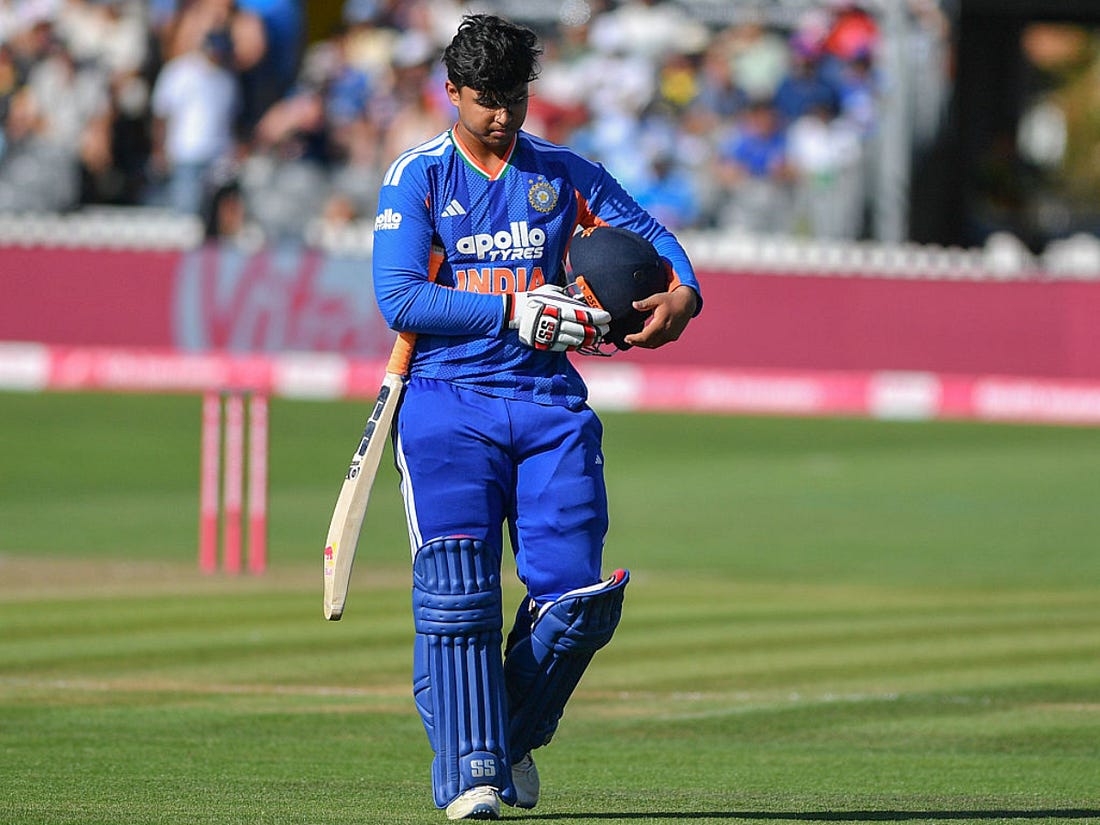
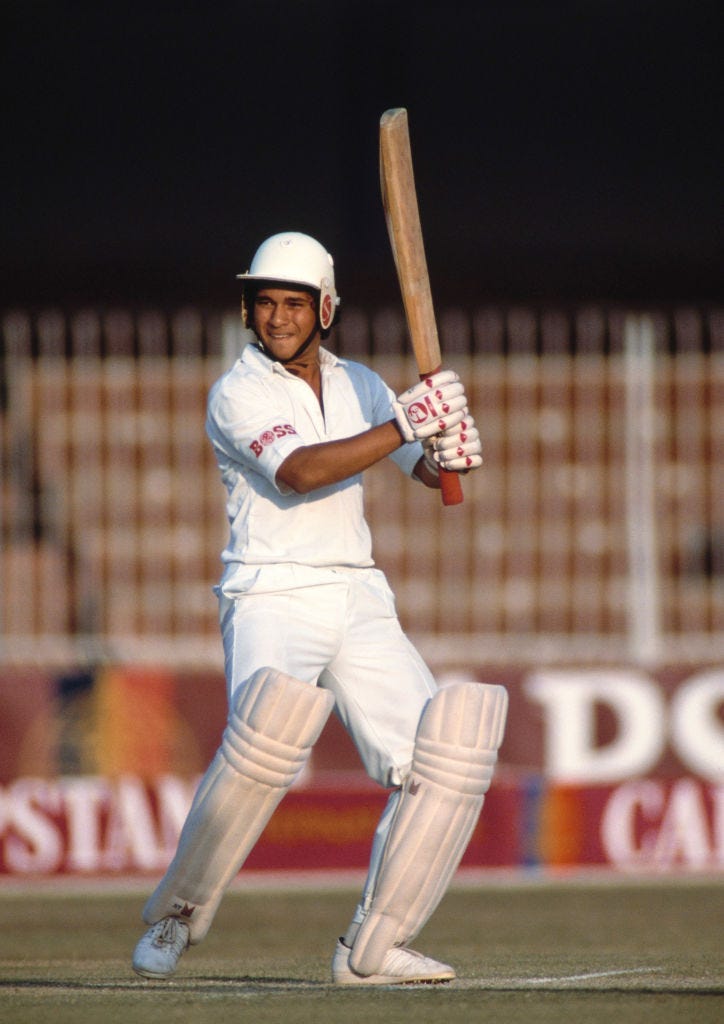
Comparisons between Vaibhav Sooryavanshi and Sachin Tendulkar became inevitable the moment the 15-year-old replaced Tendulkar as India’s youngest men’s international cricketer. Yet their first international steps reveal how misleading a straight numerical comparison can be - and how quickly Tendulkar demonstrated that he belonged at the highest level. Tendulkar made his Test debut against Pakistan in Karachi in November 1989, aged 16 years and 205 days. Sooryavanshi debuted in a T20I against England at 15 years and 99 days. One entered international cricket against a Pakistan attack featuring Imran Khan, Wasim Akram, Abdul Qadir and debutant Waqar Younis. The other was handed perhaps the most unforgiving role in modern white-ball cricket: opening the batting in England with instructions to attack from the beginning. The difference in formats is considerable. Tendulkar had time to settle, defend and construct an innings. Sooryavanshi is expected to maximise the powerplay, where even a brief stay can be considered successful if it produces rapid runs. Even after accounting for that difference, however, the early numbers produce a clear conclusion. Tendulkar’s first breakthrough arrived almost immediately. Sooryavanshi has so far offered only brief demonstrations of his hitting ability. Tendulkar built innings; Vaibhav has only produced startsTendulkar scored 15 from 24 balls on debut in Karachi, bowled by Waqar with India already under pressure. It was an unremarkable beginning, particularly when separated from everything that followed. The wait for substance lasted only one more innings. In the second Test at Faisalabad, Tendulkar made 59 from 172 deliveries. He batted for more than four hours and added 143 with Sanjay Manjrekar after India had slipped to 101 for four. It was not a spectacular innings by the standards of the career Tendulkar would eventually build. In the context of a 16-year-old playing his second international match against Pakistan, it was extraordinary evidence of concentration and temperament.
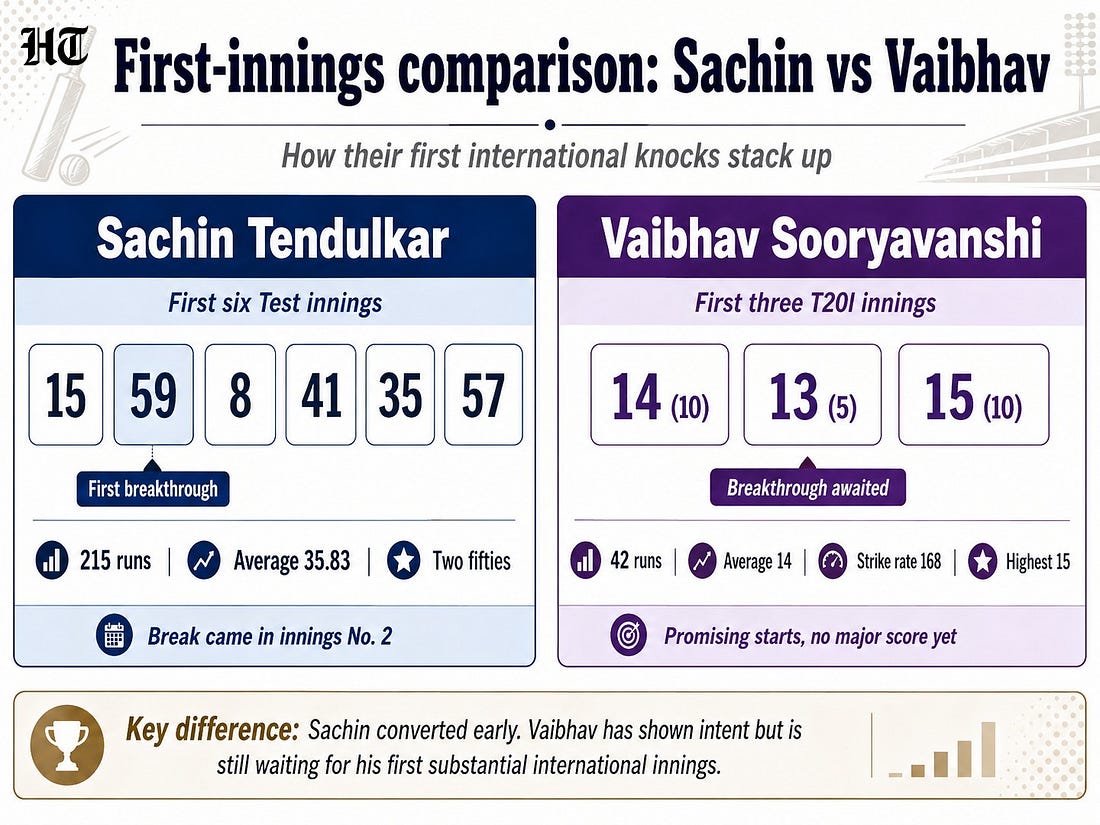
His first six Test innings read: 15, 59, 8, 41, 35 and 57. That gave him 215 runs at an average of 35.83, with two half-centuries. More significantly, Tendulkar crossed 35 four times in six innings. His opening series was therefore not built around one isolated score surrounded by failures. It contained repeated evidence that he could survive long periods and respond to one of the most demanding bowling attacks in world cricket. The 57 in Sialkot strengthened that impression. Tendulkar was struck on the face by a Waqar bouncer but continued batting as India attempted to save the Test. The innings became symbolic because of the physical courage involved, but it was also another technically important contribution. By the end of his first series, the question was no longer whether Tendulkar had been selected too early. It was how quickly his ability would develop into match-defining performances.
Sooryavanshi’s first three international innings have produced 14 from 10 balls, 13 from five and 15 from 10. His aggregate stands at 42 runs from 25 deliveries, an average of 14 and a strike rate of 168. The strike rate shows that he has not been paralysed by the occasion. He has found boundaries, attacked established bowlers and remained faithful to the method that carried him into the Indian side. But none of his innings has lasted beyond ten deliveries. That is the most revealing comparison. Tendulkar faced 172 balls in his first breakthrough innings alone. Sooryavanshi has faced only 25 deliveries across his entire international career. Tendulkar’s 59 therefore contained almost seven times as many balls as Vaibhav has encountered across three innings combined. This does not mean Sooryavanshi must start batting like a Test-match middle-order player. India have not selected him to absorb 100 deliveries. They want him to create immediate powerplay damage. A score of 40 from 22 balls could represent a major breakthrough for Sooryavanshi, even though it would look modest beside Tendulkar’s patient Faisalabad half-century. But the next developmental step is still obvious. Sooryavanshi has shown that he can hit international bowlers. He must now remain at the crease long enough to influence an international match. The expectations around him are understandable. He arrived after scoring 175 from 80 balls in the 2026 Under-19 World Cup final and had already established himself as one of the most explosive young batters in the game. His rise was based on performances, including an extraordinary IPL season, rather than merely the fascination surrounding his age. He did not reach the senior side because India wanted to experiment with a teenager. He forced the selectors to consider him through the scale and speed of his run-scoring. That pedigree can also create impatience. Because Sooryavanshi has already produced several astonishing innings at junior and franchise level, three small international scores can appear more concerning than they really are. In reality, 25 deliveries are too small a sample to judge any batter, particularly one learning how international attacks respond after identifying his preferred scoring areas. Tendulkar’s first clear break was the 59 in his second international innings. The Sialkot 57 then confirmed that the Faisalabad performance had not been a one-off. His unbeaten 119 against England at Old Trafford in August 1990 represented the next stage. That innings, scored in his ninth Test, saved India and delivered the first of his 100 international centuries. Sooryavanshi has not reached the first of those stages yet. His opening sequence has demonstrated intent without control and impact without duration. The comparison should therefore neither diminish Vaibhav nor pretend that their beginnings are equal. Tendulkar proved remarkably early that he could survive, adapt and construct an innings. Sooryavanshi has shown that he can strike at the international level. His first genuine breakthrough will arrive when those qualities meet - when the early aggression survives the opposition’s counterattack, and 14 becomes 40, 60 or something considerably larger.
|